Coldplay brings “Paradise” to El Paso
April 10, 2026
Inspire to Aspire: Everyone Eventually Comes Back to Centre Future
April 20, 2026
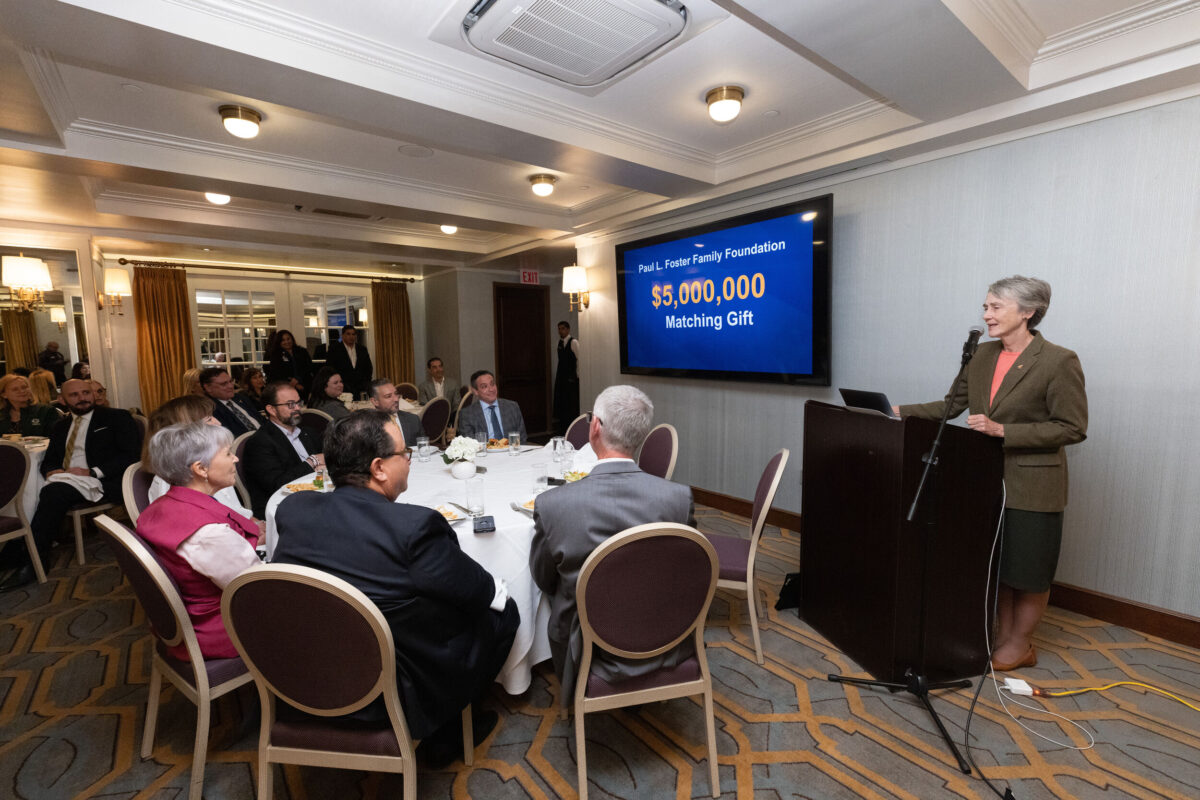
El Paso’s legal landscape could change in the near future with help from the community and the Paul L. Foster Family Foundation. In October 2025, the El Paso-based philanthropic organization donated a $5 million matching grant to the University of Texas at El Paso, encouraging residents to match the gift and support the proposed law school.
“Paul is a visionary leader who has supported the future of this community in countless ways,” said UTEP President Heather Wilson, who announced the donation. “His gift of $5 million toward the establishment of a law school at UTEP was very generous and deeply appreciated.”
UTEP leaders say a law school could help address the region’s shortage of attorneys. El Paso is also one of the nation’s largest metropolitan areas without a law school, leaving many aspiring law students with little choice but to move away for their education — and often their careers.
“El Paso is the second-largest metropolitan area in the country without a law school,” said UTEP Vice President and Chief of Staff Andrea Cortinas. “When you think about the part of the state that we’re in, the closest law school isn’t even in Texas. The closest law school is in New Mexico, four hours away.”
If the community meets the dollar-for-dollar match, the project would reach $10 million — halfway to its $20 million goal to support the law school during its first 10 years.
“The Foster Family Foundation has been instrumental in supporting these next few steps,” Cortinas said. “Without their support, we just wouldn’t be where we’re at right now. We’re extremely grateful to Mr. Foster and his family. The Foster Family Foundation gives us a great start in the pursuit of a law school in El Paso.”
The latest effort to create a public law school in El Paso formally began in 2017, when state Rep. Lina Ortega, an attorney, filed a bill addressing the need for a law school amid the region’s shortage of legal representation.
The Texas Legislature ordered a feasibility study in 2023 to determine whether a law school would be practical in Far West Texas. The study found a critical shortage of attorneys in the El Paso region and estimated that a UTEP law school could support about 100 students per entering class. One of the study’s major themes centered on El Paso’s proximity to Mexico.
“Our advantage on the border is something we at UTEP and the U.S. see as a strategic advantage in everything we do,” said Cortinas, who practiced law privately in El Paso before joining UTEP. “We’re in the largest binational, bicultural, bilingual region in the country. We view that as something that gives us strength, and specific places just don’t have that. UTEP serves our entire region. We have quite a few students who are U.S. citizens who cross the border every day from Juarez to attend college at UTEP. We also have Mexican nationals who cross the border each day to attend the university. We’re very proud of that because we’re an inclusive university.”
A new law school in the region would complement the growing need for Spanish-proficient lawyers on a regional and national level. The competitive advantage unique to future UTEP law students is the bilingualism and cultural competency the El Paso area offers. These core tenets serve a vast regional client pool, maintain the interest of future employers, and draw in prospective students in the Hispanic population.
El Paso’s role in international relations creates a demand for legal representation in areas such as immigration, energy and water rights. With relatively few attorneys specializing in those areas locally, much of that work is handled by lawyers outside Far West Texas.
“I strongly believe that a UTEP law school would fill a need for our region and the state,” Cortinas said.
The law school would also require a building to house classrooms, faculty and staff offices, moot courtrooms and student gathering spaces. With limited space for growth on campus, UTEP is still evaluating possible sites. Preliminary estimates for capital costs range from $66 million to $110 million, including the building and soft costs such as permits, furniture and technology.
After determining whether there is enough support in the region, the university’s next step would be to take its request for approval to the Legislature in 2027.
“El Paso is such a special community,” Cortinas said. “Nothing in El Paso gets done alone. Everything that we are able to do is because of the community. It’s there because we have come together and we’ve worked together to achieve it. The law school is no different. This is a community endeavor, and it will take everyone coming together to make this happen.”